
 Editorial Team
When shopping for an active phone cooler, one spec dominates product listings: wattage. Models range from basic 15W units to high-performance coolers pushing past 30W. It is natural to assume that choosing the highest number guarantees the fastest cooling.
Higher wattage provides greater cooling potential but performance gains do not scale linearly. While more power allows a cooler to absorb heat faster, internal phone bottlenecks and thermal dissipation limits quickly create diminishing returns.
Here is how wattage affects real-world cooling, where the physical limits lie, and how to choose the right power output for your needs.
How Wattage Drives Phone Cooler Performance
Most active phone coolers rely on a Thermoelectric Cooler (TEC), also known as a Peltier module. When an electric current flows through a TEC chip, one side becomes freezing cold while the other side becomes extremely hot.
-
The Cold Side: Clamps directly to the back of your phone to pull heat away from the chassis.
-
The Hot Side: Transfers heat into an aluminum heatsink, where a fan blows it out into the surrounding air.
Wattage measures the electrical power drawn by this system. Higher wattage allows the TEC module to move heat more aggressively. However, generating extra cooling power also creates significantly more heat on the hot side. If the fan and heatsink cannot dissipate that excess heat, overall performance suffers.
The Bottleneck: Why Higher Wattage Has Limits
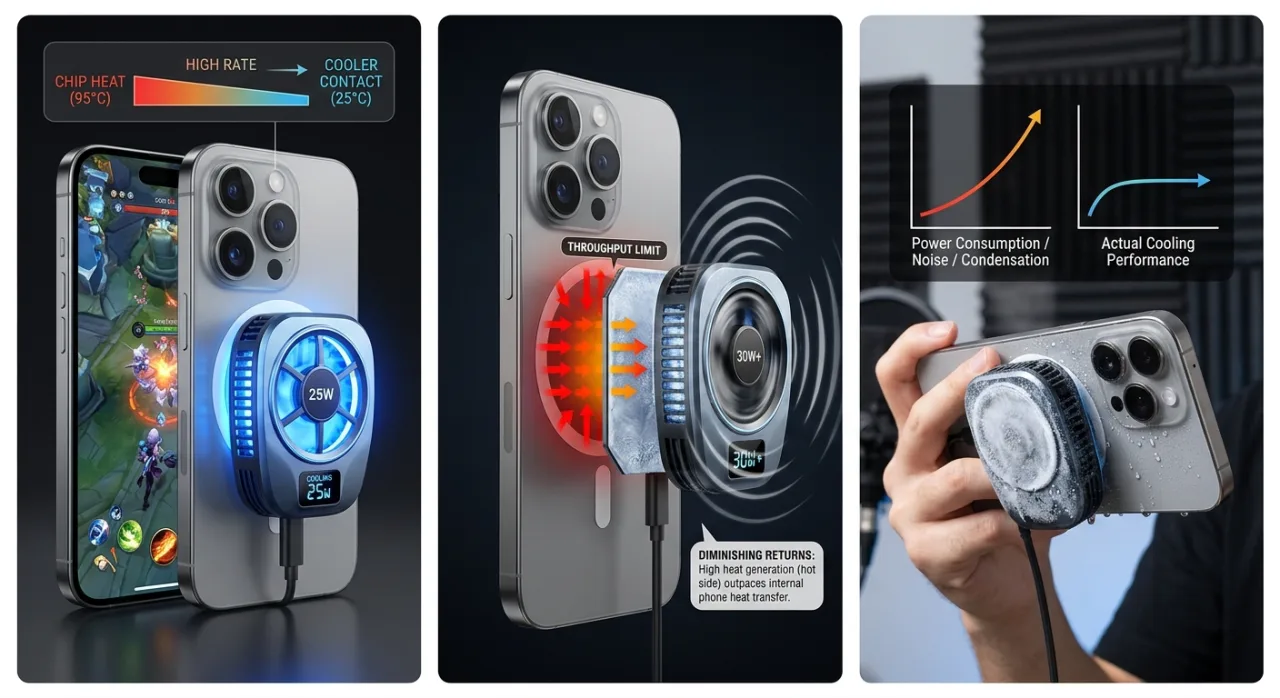
A high-wattage cooler drops surface temperatures rapidly, especially when your phone is running hot from heavy gaming or long 4K video recording. However, doubling the wattage will never double the actual cooling performance.
[Phone Processor] ➔ [Internal Layers] ➔ [Back Panel] ➔ [Cooler Contact Plate] ➔ [Heat Dissipated]
                                 ▲
                     Thermal Bottleneck Occurs Here
Heat generated by the phone processor must pass through multiple internal layers, thermal paste, adhesives, and the outer case before reaching the cooler plate. This heat transfer path is the true bottleneck.
Once a cooler reaches the maximum rate at which your phone can transfer heat outward, extra watts simply chill the cooler plate itself rather than pulling additional heat from the processor.
The Hidden Trade-Offs of High-Wattage Coolers
Chasing maximum wattage introduces several practical drawbacks that impact day-to-day usability:
-
Increased Fan Noise: High-wattage TEC modules generate massive amounts of waste heat. Clearing that heat requires faster, larger fans, which produce noticeable noise during calls or video recordings.
-
Rapid Battery Drain: High-power coolers draw significant energy from the host phone port. Without a dedicated power bank or wall adapter, phone battery life drops precipitously.
-
Condensation Risk: An extremely cold contact plate pulls ambient moisture out of humid air. This condensation can gather around phone seams, ports, and camera modules.
-
Severe Diminishing Returns: Jumping from 10W to 20W delivers a noticeable temperature drop. Jumping from 20W to 30W yields much smaller gains while doubling power consumption and noise.
Recommended Wattage by Use Case
Matching wattage to your specific workload prevents unnecessary power draw, noise, and moisture risk.
| Primary Use Case | Recommended Wattage | Key Priorities & Operational Setup |
|
Light Use (Browsing, streaming, casual play) |
10W – 15W | Low fan noise, minimal power draw, zero condensation risk. |
|
Content Creation (4K/8K video recording, live streaming) |
15W – 25W | Consistent thermal management without loud fan noise ruining audio. Use external power. |
|
Heavy Mobile Gaming (Max graphics, high frame rates) |
25W – 30W+ | Maximum heat suppression to prevent thermal throttling. Pair with a power bank. |
Debunking Common Phone Cooler Myths
Myth 1: “A 30W cooler is twice as effective as a 15W cooler.”
Fact: Wattage measures electrical power input, not heat removal output. Once your phone reaches its maximum rate of heat transfer, extra wattage creates fan noise and power drain without delivering additional cooling.
Myth 2: “Wattage is the only spec that matters.”
Fact: Thermal design plays a massive role. Contact plate flatness, thermal pad quality, heatsink surface area, and fan airflow determine real-world performance. A well-engineered 20W cooler routinely outperforms a poorly built 30W model.
Final Takeaway
Higher wattage increases cooling potential, but hardware bottlenecks limit how much of that power actually benefits your processor. Rather than buying the highest wattage available, select a cooler built for your specific workload, pay attention to build quality, and prioritize low fan noise and efficient heat dissipation.